Sunday, 4 January 2015

LIGHTSHIP CORMORANT / LADY DIXON - Chapter 77a


In October I received a message from Alex Coulter, who sent me some information about the Lady Dixon when she was a Pilot Station in Belfast Lough….
.
Hi David, I read the story of the Lady Dixon with great interest. My father John Coulter worked for 23 years in charge of the Pilot cutter Rosa. She carried the Ships Pilots that piloted ships into Belfast. The Pilot Master, Pilots and deck crews lived aboard the Lady Dixon.  Dad would take the Pilots down to go aboard the Lady D. The 2 Pilot Masters were David Hunt and James Owens. I went with him a number of times. When the Lady D was off for overhaul her replacement was the Sir Thomas Dixon - an old Steam Yacht.  I hope you find this information helpful. I went on to go to sea and years later I was Tug mate and Skipper in the tugs Somerton and Sir Kenneth for the B H C.
Regards.
Alex Coulter.

To which I replied ….

Hi Alex,
Many thanks for that historical snippet. I have a copy of the Lady Dixon Log Book for September 1956 and it shows J Owens as the Pilot Master at that time. It also shows the names of the Pilots on board each day, which ships they boarded and what the weather was like!
I also have a copy of the BHC Board minutes from 26 Jan 1960, which record that the Lady Dixon was to be dry-docked, to be replaced on station by the Commissioners' tender Sir Thomas Dixon.
Your memory is obviously working well!
Best wishes
David

He came back straight away …..

David,  the post brought back many happy memories. I knew a number of the Pilots in question as I was a Berthing Master in Belfast after my time in the tugs of the B H C.
Regards,
Alex C R666116.

I then lost track of these messages (sorry Alex), but having found them again I have included them here – they are the first direct link with Simon’s vessel during her working life.

Friday, 2 January 2015

LIGHTSHIP CORMORANT / LADY DIXON - Chapter 77


A happy New Year to all my readers!
I gave some serious thought to the suggestion that I should write a book on the history of ‘Cormorant’.  Just repeating these posts would not produce a coherent story (or a lot of interest!), so it would have to be properly done, flavouring the cold facts with historical detail and evidence.  I even started to sketch out the first chapter, beginning in 1876/8 when ‘Cormorant’ was built by the Victoria Shipbuilding Co., West Passage, Cork. That is where I hit the first snag. 
   I have always accepted that statement as fact because it is quoted in many sources, but I can find no record of that shipbuilding company. I know where West Passage is and it did have a flourishing shipbuilding/repair industry in the mid-1800s. I have found the Royal Victoria Dockyards;  the Passage Docks & Shipbuilding Co;  the Cork Shipbuilding Co. Passage West;  and others;  but no mention of the Victoria Shipbuilding Co. Well I am off to Dublin in a couple of weeks, so hopefully I will be able to determine whether this is a case of someone getting the name wrong and everyone afterwards repeating the mistake (instead of doing their homework properly!).
   Meanwhile Patrick (SailPix) sent me a link which shows a mailboat delivering to a lightship on the Kish Bank station. A great deal of smoke was being puffed out by the mailboat, so it is not possible to identify the lightship. That little speck in the water is probably the lightship cutter going back to mother after collecting the mail.  I wonder why the mailboat crew are wearing cloche hats!
David

Saturday, 27 December 2014

LIGHTSHIP CORMORANT / LADY DIXON - Chapter 76


For the final chapter of the year I have chosen to look back to remind myself how far Simon has got with this massive project. It really ought to be on Amazing Spaces!
   The many improvements Simon has made, since deciding to purchase and live aboard in August 2013 (only 16 months ago!), include the refurbishment of the 58x18ft deckhouse, turning a tiny ‘cooking space’ and a rubbish store into a terrific kitchen (Photos 1, 2 and 3).  Note that Photo 3 is a combination of two photos, which accounts for the two-tone floor!


    The other great step forward was the insulation and weather proofing of the whole 58 sq metre deck area, particularly the side decks which were full of holes with no cladding (Photos 4 and 5). 


  So a Happy New Year to all my readers.  I am running this story on several web-sites and the total  ‘hit count’ has just passed 47,000, running at about 800 to 900 per week, so there are people out there who are interested‼
David

Tuesday, 23 December 2014

LIGHTSHIP CORMORANT / LADY DIXON - HELP!

This site has some awkward, nay contrary features.  Sailpix IRL left a couple of comments about Chapter 65 (October) and I have only just received notification that the comments have been left. Not that it is doing me much good because I cannot work out how to respond. Clicking on the 'reply' button presents me with a new box for about 1.5 secs and then reverts to Sailpix's comments again. The Help pages are useless. Can anyone out there help?
Anyway Sailpix, Patrick, thanks for the compliment. In answer to your questions, paintings are not really accurate enough to identify individual ships (artists' license and all that).  I have seen the two Wilkinson paintings before, but the Mailboat photo is a new one on me. Thank you for it, but what a pity the Mailboat was making so much smoke and obscuring the lightship!
David

Friday, 19 December 2014

LIGHTSHIP CORMORANT / LADY DIXON - Chapter 75


Well the London Metropolitan Archives pulled out the stops and my photo, ordered on Thursday, arrived the following Monday!  I had to ask permission to reproduce it here, but that did not take long. It shows a hoistable lantern close up (Photo 1 © Trinity House).


The construction of the 2 ton 13 cwt monster can be seen clearly and the crew member alongside gives a good impression of the size.  I assume that chain is for hauling the lantern up the mast by means of the manual (?) windlass at the bottom of the photo. Although those chains look fairly vertical, they cannot be. The windlass must be nearer to the camera than it looks so that the chains do not foul the lantern when it goes up. However, in all the photos I have of these lightships with hoistable lanterns, I can find no clear evidence of stout chains near the mast. I can see block and tackle arrangements such as on the Owers lightship (Photo2).

     I say this as a plural because there is one forward as well as the expected one aft. Perhaps it took two windlasses to hoist the monster aloft? Or perhaps these are nothing to do with the lantern – in which case where are the chains? 

   Incidentally, the Owers Station is off Selsey Bill and I gather that one lightship with the name Owers is now a wreck in Tel Aviv harbour. I don’t think it will be this one.

   The other question refers back to discussions we had on sails. I assume that is a furled sail stretching towards the lantern and, as it looks very straight, I assume it is around a spar/ boom. There does not appear to be any rigging keeping it up. It must be hanging (sorry, wrong term) from the mizen and possibly anchored (sorry, wrong term) to the main mast or superstructure near it, but I have never seen a sail in that position in any of the old photos. There have been photos of furled sails and just one unfurled (Photo 3) – all aft of the mizen. So come on you experts, what is going on?

   The renovation has picked up speed and the deck is now completely insulated and weather-proofed. The bow has never looked so good! (Photo 4).

    I know some of you will be wondering what that large blue tray is doing there. Well it’s where Molly – Simon’s dog – empties her bladder in between trips ashore. The observant amongst you will notice that it is slightly tilted by those green blocks. This is to encourage the effluent down to the bottom left corner where there is a gap in the surround. Although hidden by a hanging basket (of dead flowers) the gap is positioned over the starboard haws pipe …. need I say more?
David

Saturday, 13 December 2014

LIGHTSHIP CORMORANT / LADY DIXON - Chapter 74


I was not too hopeful of finding a great deal in the London Metropolitan Archives.  Yes they have a collection of Trinity House documents and photos, but Trinity House was hit by a bomb during WWII and much was lost. However, the LMA do have very helpful staff and they helped me to find a few nuggets.
     What I was looking for was a record of the Puffin tragedy (1896), or at least an expression of official sadness. I also wanted to find confirmation of my theory that the Court of Inquiry findings – that the sinking was most probably caused by the mast breaking – prompted both Trinity House and the Commissioners for Irish Lights to change the design of all the main masts on their lightships from having a hoistable lantern to having a fixed one. See my previous post.
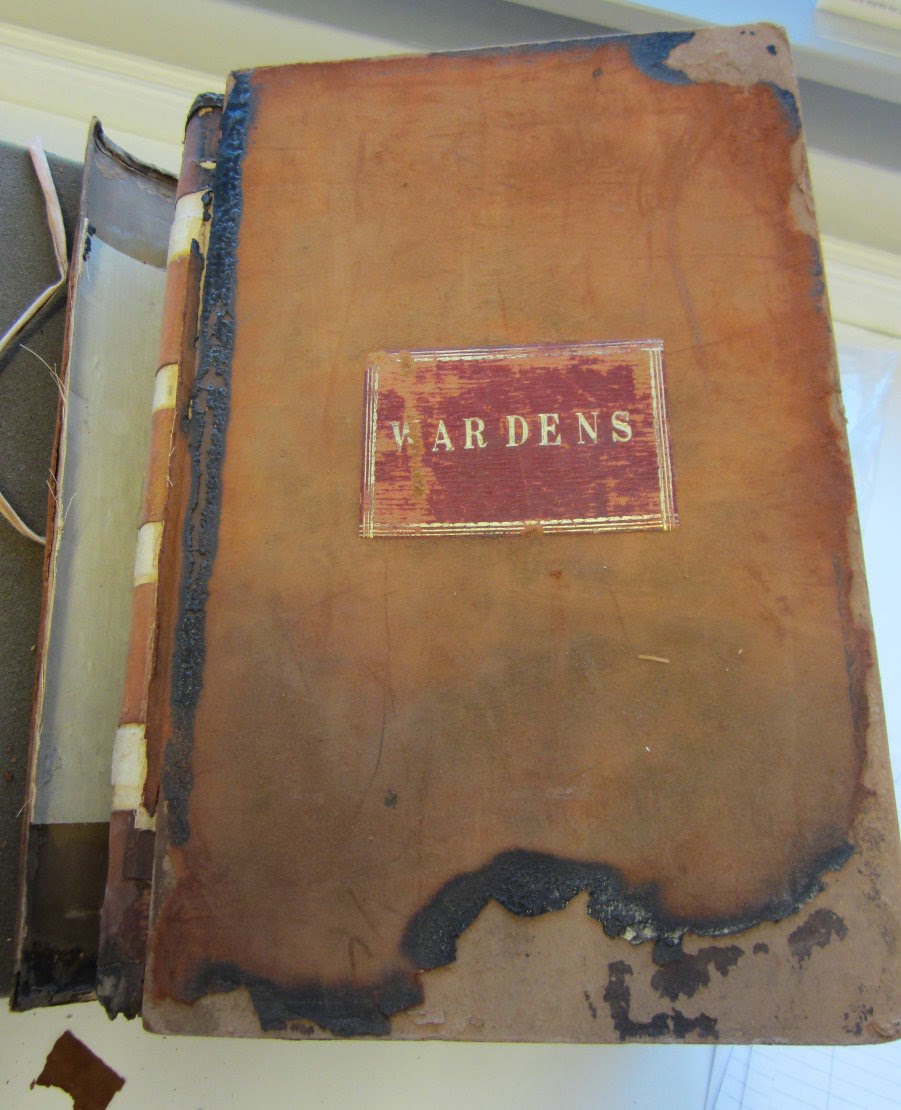
    I searched through a number of large, bound volumes of ‘Wardens’ Minutes’. They had been nicely bound but, after 120 years, were showing their age and were more than a little fragile (Photo 1).  


 I went right through 1896, 1897 and 1898, but found nothing relating to the Puffin.  I did see a reference to the Siren LV and new steel masts in January 1900. On a totally different subject there was a note about trials of an ‘incandescent gas burner’ in December 1897. The cost was to be £35 (about £3,500 in today’s money).
    There were some photos of light vessels and I have ordered copies of two of them.  One is a close-up of a lantern sitting at deck level and hopefully these will not get too delayed by the Christmas post. They are being copied from old glass slides (which I was not allowed to touch!)
    There was a shot of Petrel on the Coningbeg station. It took some computer jiggery-pokery, but I can just make out her name on the stern above that white band (Photo 2).

    I also trawled through ‘Inspection Books for Light Vessels’;  ‘Visiting Committee Reports’;  ‘Buoy Books’; and ‘Board Agendas (Pilotage)’. Nothing interesting in that lot!  However I do now know how to operate an 1895 Manual Fog Signal Apparatus. I also discovered that at a Board meeting on 11th February 1941, the Rt Hon Winston L S Churchill CH MP was fined one shilling by his fellow Board Members for lighting a cigar at the meeting. Not a lot of people know that!
    Towards the end of my second (and last) day, I was casting about rather desperately for lightship items, when one of the staff unearthed some other bound volumes and I struck gold.

17 October 1897:  “Irish Lights and Surveyor of Shipping.  Asking that Mr Goodall be allowed to inspect the old Daunts Rock Lt Vsl “Puffin” which is expected shortly to be dry docked at Cork.  Approved”.
In fact the Puffin wreck was beached, inspected there and broken up there.

19 October 1897: “Irish Lights (Lt Vsls).  Forwarding copy of Report of Court of enquiry into the loss of Daunts Rock Lt Vsl “Puffin”, who attribute the disaster to the breaking of the steel mast, which tore up a large portion of the deck. In consequence of this finding of the Court, the Commissioners of Irish Lights, with a view to the prevention of similar accidents in future, propose to introduce a stronger description of mast for use on board the other Light Vessels in their Service.
The Board of Trade now request the observations of the Elder Brethren upon this proposal of the Commissioners.”

Bingo!  Put another way “The Irish are putting stronger masts in their light ships, shouldn’t we be doing the same?” A very satisfying end to my labours. I now look forward to my trip to Dublin in January, where I hope to find some more nuggets.
David